
Operating model
When shipping gets cheaper, judgement and ownership matter more.
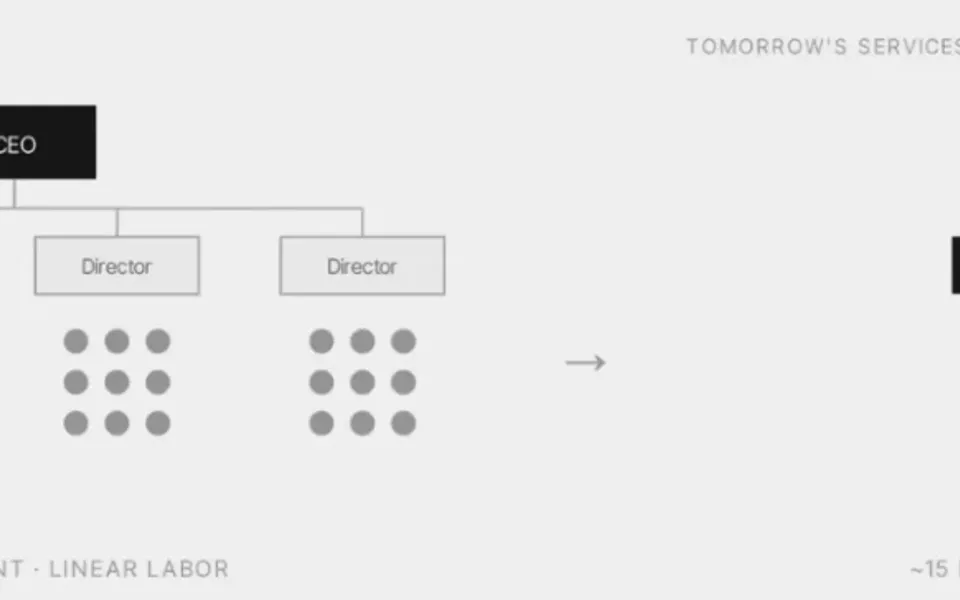
Two claims, one tension
If shipping spreads, shipping alone cannot be the moat
The slide above makes two claims. First, AI tools let people without traditional engineering backgrounds put useful systems into production. Second, a services firm with more than two hundred people can become one with about fifteen, each directing automated workflows. The first is an observation about access. The second is a workforce scenario. A diagram does not establish that the second follows from the first.
The tension is still valuable. If more firms can produce and deploy competent software, then the act of shipping becomes a weaker differentiator. It does not become effortless or universal. Security, integration, regulation and maintenance still make production difficult. But “we can build it” carries less strategic weight when customers and competitors can build more of it too. The scarce question moves from whether something can ship to whether it deserves to exist and can be trusted once it does.
A workforce forecast is not a redesign plan
Cheaper production can change roles, but headcount does not follow from one capability slide.
Forecast shortcut
- AI increases output A capability or productivity claim.
- Fewer people are needed An inference that omits demand, quality and coordination.
- 200 becomes 15 A scenario, not an evidenced organisational law.
replace arithmetic with work design
Responsible redesign questions
- Which work disappears? Separate tasks from whole jobs.
- Which work grows? Verification, ownership, customer judgement and governance.
- How will people transition? Training, sequencing, accountability and humane support.
Treat dramatic headcount numbers as hypotheses that must survive operational and human evidence.
Where value can move
Output becomes abundant before judgement becomes cheap
AI can lower the cost of producing one more draft, analysis, code change or customer document. That creates output abundance: a team can produce more plausible options before lunch than it could previously review in a week. The economic effect is directional, not guaranteed. Some markets will absorb more output. Some will lower prices. In others, regulation, physical work or specialist knowledge will keep delivery expensive.
What often becomes scarcer is the capacity to choose a worthwhile problem, provide authoritative evidence, test the result and accept responsibility for its consequences. Model access is increasingly something firms rent from the same market. The retained advantage is a disciplined understanding of customers, decisions and quality. When production gets cheaper, judgement does not automatically become more valuable, but firms that cannot exercise it can now waste money and attention at greater speed.
When production gets cheaper, value can move
The shift is conditional: different work retains different bottlenecks and different human responsibilities.
Lower-cost production
- Drafting and transformation Models can reduce time for many first-pass outputs.
- Routine implementation Known patterns may become faster to express.
- Variation at scale More alternatives can be generated cheaply.
value may shift
Scarcer work
- Problem choice Deciding which outcome deserves effort.
- Verification and judgement Testing claims against reality and consequence.
- Ownership Remaining accountable after the output ships.
Do not assume every role crosses the same point or that human work only shrinks.
A worked example
Twenty reports do not create twenty useful decisions
Consider an agency that prepares monthly performance reports for twenty clients. An AI workflow can collect approved metrics and draft all twenty reports quickly. Output is no longer the bottleneck. During one month, however, a tracking outage makes conversions appear to have fallen. The draft confidently recommends cutting a campaign. A useful system must flag the missing data, cite the source, compare it with the outage record and route the recommendation to the account owner.
The valuable work sits across the chain. Someone chose which client decision the report should support. Someone defined acceptable evidence. Someone tests whether the workflow catches a known data gap. In this case, the account owner pauses the proposed cut, corrects the report, tells the client why the evidence changed and records the outage as a future evaluation case. Automation can assist each step, but producing twenty polished documents does not discharge those responsibilities.
The work continues after generation
A shipped output enters a chain of responsibility that the model cannot own.
- Choose the problem Name the person, consequence and desired change.
- Produce a candidate Use people, models and tools to create the first result.
- Verify in context Test behaviour, evidence, permissions and failure modes.
- Release deliberately Sequence adoption, monitoring and reversibility.
- Own the outcome A named person responds when reality disagrees.
Shipping is a transition into ownership, not the end of the work.
The organisational question
Redesign responsibility before you count seats
An exact forecast such as two hundred people becoming fifteen cannot be read from model capability alone. Demand may grow. Customers may expect more service. New review, integration and governance work may appear. Some tasks will disappear, some roles will change and some jobs may be lost. The outcome depends on the business model and on choices made by leaders, not only on the technology.
Start by mapping responsibility. Which decisions require named owners? Where does frontline knowledge live? What must a person be able to challenge or stop? How will people whose tasks change learn the new work? Reducing headcount before answering those questions can remove the very knowledge needed to evaluate the automation. A governed shared memory can preserve decisions and evidence, but it cannot replace fair transition, domain experience or accountable leadership.
The operating consequence
Leverage can concentrate fragility
A smaller team with reliable automation may be more resilient than a larger team performing brittle manual work. It may also concentrate risk. If one workflow supplies every client report, a stale definition or broken connector can affect the whole portfolio before a person notices. The relevant measure is not people divided by outputs. It is the failure surface: how many decisions depend on the workflow, how quickly drift is detected, who can intervene and how the business operates while it is unavailable.
This is why the difficult part of enterprise AI is often the production system around the prototype: authorised data, monitoring, release checks, incident ownership and safe failure. Automation earns leverage only while those controls remain maintained. The cost does not end when the first version ships.
The honest operating model
Make judgement visible before making production cheap
A leaner firm is possible, but it is not the only plausible future. Cheaper production can also support more experiments, more personalised service and new work that was previously uneconomic. Human judgement is not automatically correct either. It needs evidence, challenge and review. The practical aim is not to preserve every old task or automate every available one. It is to make the decision chain explicit.
For each workflow, ask four questions. Problem: which real need does this serve? Proof: what evidence demonstrates acceptable work? Owner: who approves the outcome and maintains the system? Failure: how is harm contained and work recovered? If those answers are missing, faster shipping increases activity without creating dependable value.
The human consequence belongs in the operating model, not in a footnote. Productivity can fund better work and return attention to judgement, learning and relationships. It can also transfer risk to fewer people while removing livelihoods from others. Technology does not choose between those outcomes. Leaders do. Shipping may become table stakes. Choosing, verifying and owning what ships remains the job.